
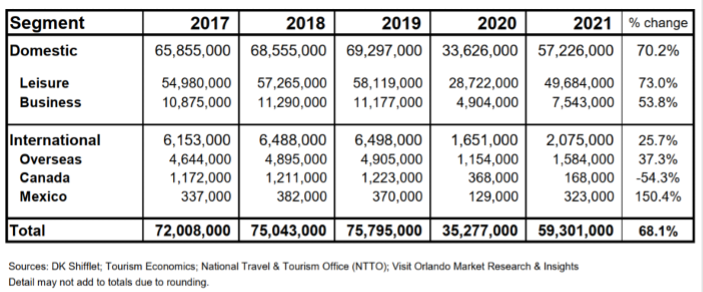
While New York is the most visited U.S. city by foreigners, Orlando is the city with the highest number of total visitors – 75.8 million in 2019, before the pandemic. According to data from the governmental association Visit Orlando, there were 69.3 million domestic visitors and 6.5 million foreign visitors, ahead of the Big Apple's 66.6 million total visitors in the same year, with most travelers on leisure trips.
Beyond the colossal number of tourists, its growth is also impressive: from just over 50 million in 2010 to nearly 76 million in 2019, a 52% increase that was only interrupted by the pandemic. Even so, despite the major impact of COVID-19, the number of visitors continues its strong recovery, and the 2019 record is expected to be broken as early as 2023.
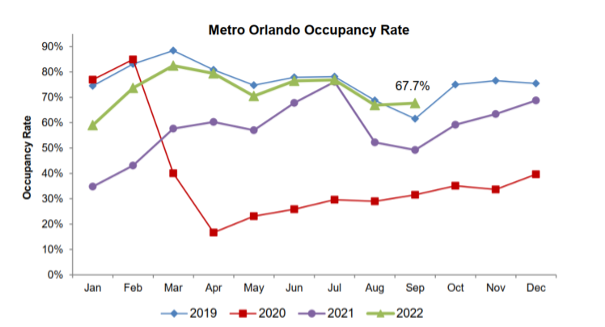
Although 2022 visitor data has not yet been compiled by Visit Orlando, the city's hotel-industry statistics show how the market has already practically recovered its 2019 occupancy levels, as can be seen in the chart below.
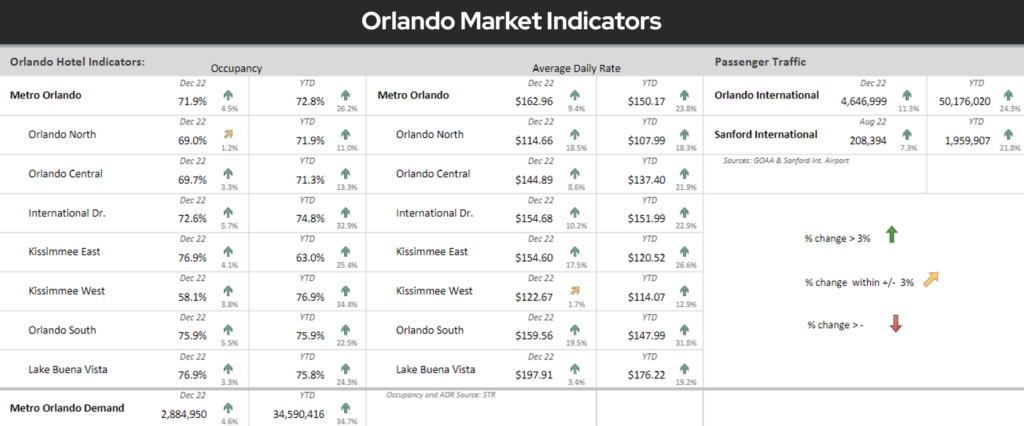
In 2022, with some data compiled through December, the market's recovery is evident. Occupancy in the Orlando metropolitan region closed the year at 72.8%, reaching as high as 74.8% and 75.8% in the International Drive area and in Lake Buena Vista, respectively, historically the two best areas for tourism in the city. Average daily rates (ADR), meanwhile, far exceed those of 2019, standing at US$ 150 on average for the metropolitan region and at US$ 152 and US$ 176 on International Drive and in Lake Buena Vista, respectively.
The theme parks and the next visitor boom
As one would expect, the theme parks are Orlando's main attraction. What many may not know is that this market is in full expansion. Disney and Universal Studios are waging a battle that, in practice, has revolutionized the segment and attracted more and more visitors to the city. Since the opening of The Wizarding World of Harry Potter at Universal, the companies' new battlefield became clear: the creation of an unprecedented immersive experience. With the contribution of visual effects and unprecedented realism, visitors are transported into a world of fantasy, where everything evokes the stories and characters of the series.
In response to the Harry Potter park, Disney also advanced in the battle for visitors' experiences (and wallets) and launched Star Wars Galaxy's Edge. In the park, the visitor, like a galactic adventurer, is invited to explore the attraction, which has no well-defined circuit. In both cases, the idea is for the visitor to be able to return again and have different experiences each time.
However, the most recent and important chapter of this battle is underway: Epic Universe. Slated to open in June 2025, Universal's new mega park will be the most modern in the city and the largest opening since 1999. The park will feature among its fantastic worlds “Super Nintendo World,” the “How to Train Your Dragon” franchise, the “Universal Monsters” (Dracula, Frankenstein and the Wolfman) and, of course, another Harry Potter park.
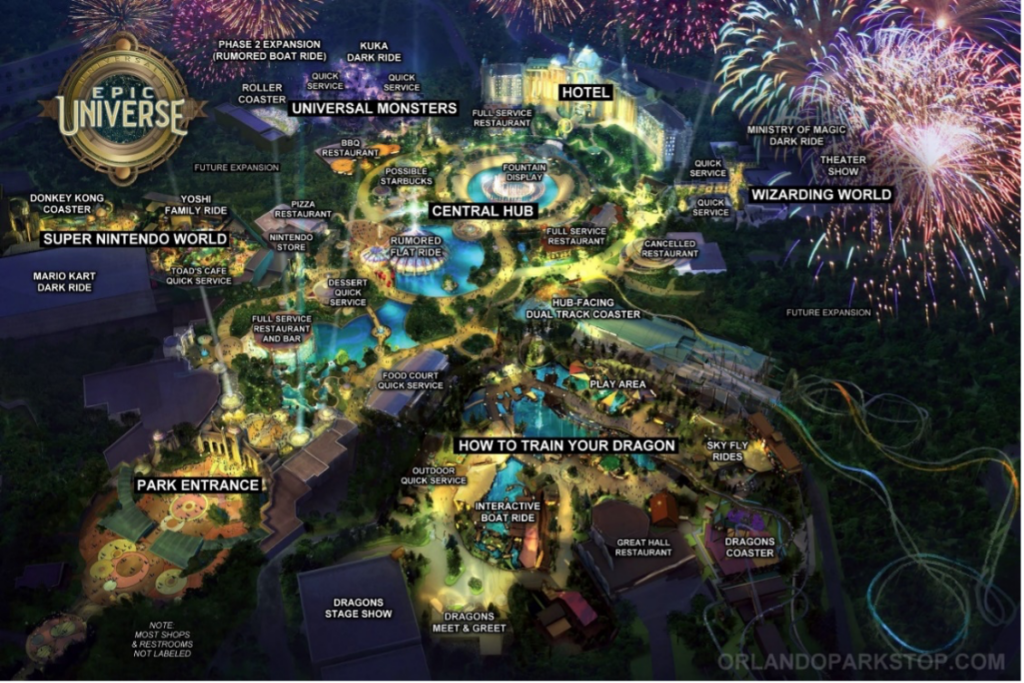
Although there is no official information on the number of visitors expected for the new park, local authorities estimate an additional positive impact of US$ 11 billion per year on Orlando's economy and the creation of 14,000 new jobs. For the city's hotel sector, more than 11,000 new rooms are expected to be needed.
Orlando: far beyond the theme parks
In addition to the growth of leisure tourism, Orlando has also solidified itself as an important business and corporate destination in the U.S. One indicator of this movement is the city's growth as an important convention center in the U.S., with the Orange County Convention Center being the second-largest convention center in the country.
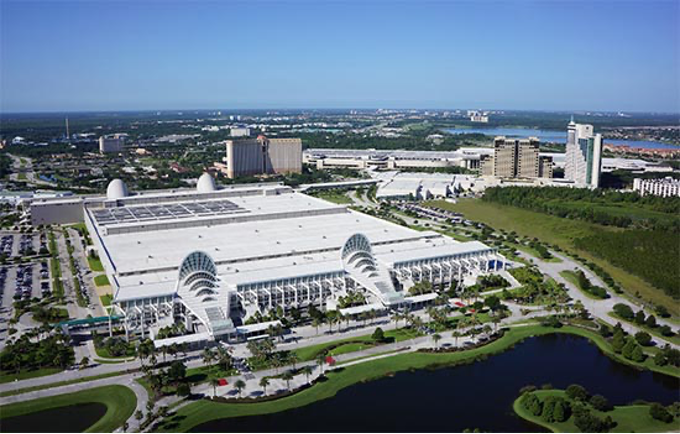
Naturally, the sector that employs the most in the Orlando region is entertainment and hospitality, with the Walt Disney World complex being the largest single employer, with around 58,000 employees. Universal, meanwhile, employs more than 21,000 people in the region, before the opening of Epic Universe. However, the local economy is not based solely on entertainment, and other important sectors have stood out, such as healthcare and education. AdventHealth and Orlando Health, for example, employ 37,000 and 20,000 people respectively. The University of Central Florida, meanwhile, employs more than 12,000 people. Some advanced-manufacturing companies also have a prominent presence in the region, such as Lockheed Martin, with around 10,000 employees, and Siemens Energy, with around 5,600 employees.
Thus, Orlando has also gained prominence as a city that attracts new companies and people, in a self-reinforcing cycle. People are attracted by the relatively low cost of living, the warm climate, the absence of a state income tax and the growing number of jobs. Companies, meanwhile, are attracted by the ease of doing business in the state, the large pool of skilled labor in the region, which totals more than 550,000 higher-education students within a 160-km radius of the city center, and the growth of the consumer market.
Investment opportunities in Orlando
As one of the fastest-growing metropolises in the U.S., Orlando's entire real estate market ends up benefiting directly or indirectly from its development. However, two segments in particular stand out in the city: residential and hospitality.
The population increase naturally drives demand for new homes and, in the current market moment, one of the most interesting options is in Build-to-Rent. More information on this movement can be found in the article Trends in Private Real Estate Investment in the U.S. for 2023.
The other segment that should gain strong momentum is tourism, especially with the opening of Universal's new park in 2025. Although the entire hotel industry should benefit, it is natural that the region surrounding the new park will become more attractive. In this case, the main options for investment are in hotels and vacation homes. It is important to note, however, that the vacation homes market is still quite fragmented and not very professionalized. Thus, this type of investment tends to make sense only when it is done professionally, using experienced operators, large scale and active management.
Conclusion
Although it is better remembered by Brazilians as a tourist destination, Orlando is one of the fastest-growing American metropolises in the country. Starting in 2025, with the opening of Universal Epic Universe, a new growth cycle is expected for the city, driven by its flagship: experiential tourism. Thus, combining quality of life, a warm climate, a low cost of living and ease of doing business, the city has been one of those receiving the most new residents and new companies, and is therefore an excellent option for those who want to invest in the local real estate market as well.