
March cemented the U.S. as one of the world's leaders in COVID-19 vaccination
The country reached the mark of 85 million people vaccinated with at least one dose administered – which corresponds to more than a quarter of the adult population – with 46 million people having already received two doses. The expectation is to reach the threshold of 70% of the population immunized as early as July, a number sufficient to begin the return to normal life and which projects a gradual and solid reheating of the economy¹.
In addition to mass vaccination, on March 11 President Biden signed the American Rescue Plan Act, a stimulus package that will inject US$ 1.9 trillion into the U.S. economy, accelerating the recovery of various sectors. The package includes US$ 400 billion in checks for the population, US$ 50 billion for small businesses, covering hotels and restaurants, and US$ 21 billion to help with rent payments².
Investor confidence in the U.S. continues to increase, and Ativore, a specialist in the country's real estate market, is betting on accelerated growth in the sector in 2021. The company's private real estate portfolio showed strong resilience to the pandemic³, and its managers believe that the new economic context has created unprecedented opportunities.
In moments of uncertainty, many institutional investors tend to move their capital toward investments considered safer, the so-called “flight-to-safety.” The real estate market, despite being characterized as an alternative investment, remains one of the most traditional in the world, and has historically offered very safe characteristics and returns to investors. It is no coincidence that a recent study using data from the NCREIF Property Index (NPI)4 and NYU Stern5 and consolidated through Yahoo Finance demonstrated that, over the last 20 years, private real estate funds outperformed stocks and government bonds with significantly lower volatility than other asset classes.
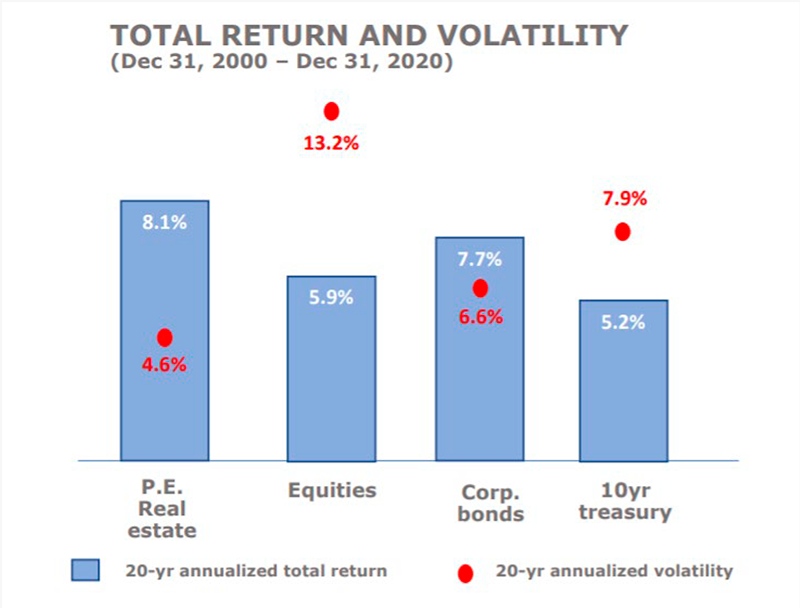
Source: Yahoo Finance, NYU Stern, NCREIF Property Index (NPI). 20-year period, ending December 31, 2020.
Private Equity Real Estate returns are measured quarterly, unlevered. Equity returns represent the returns of the S&P 500, including dividends.
The uncertainties of 2020 prompted the sale of assets at more discounted prices6
On the sellers' side, the uncertainties of 2020 prompted the sale of assets at more discounted prices6 due to various factors such as: the need to liquidate assets to generate cash, management difficulties for operators not specialized in crises, shareholder pressure in the case of public markets, challenges in managing debt payments, and the possibility of asset foreclosure by financing agents. These factors proved to be even more present in secondary markets, considered more volatile, and in properties requiring greater active management capacity, dependent on the competence of their administrators.
Historically low interest rates as a major differentiator for overseas investment
For buyers, on the other hand, the environment of historically low interest rates allows gains to be greatly amplified with leverage, as long as there is a secure financing structure and high debt service coverage. However, if there is a very strong increase in economic activity in the U.S., it is possible that interest rates will rise further to contain such advance. This highlights the importance of locking in financing interest rates now, expanding the profitability of operations. All these factors indicate an opportunistic buying window in the U.S. in the short term (2021 and 2022), with no guarantees that the low cost of capital will hold for the coming years.
In demographic terms, the pandemic decisively accelerated the migration from large cities such as New York, Chicago and Los Angeles to cities in the Sun Belt region, where there are lower taxes, lower living costs, and a more pleasant climate throughout the year. This region already holds more than half of the U.S. population, and forecasts are for it to grow another 55% by 20307. In this context, the standout states are Texas and Florida, which have received a strong migratory flow and welcomed many multinational companies, such as the recently arrived Oracle and Hewlett Packard Enterprise. Following this population trend, the Sun Belt has been emerging as the largest market for investments in the U.S. in the coming years, especially in the suburbs, where there is a better quality of life.
As for sectors, it is clear that the most affected sectors are those that can generate the highest potential returns. While multifamily and industrial properties remained strong, retail and hospitality continue to offer acquisition opportunities at stressed prices, which could surprise positively in the medium and long term with the increase in the vaccination rate. Retail is adapting to the online sales environment, with more tenants adopting omnichannel sales models and a greater focus on essential, strictly in-person and experiential services such as supermarkets, gyms and restaurants.
The hotel segment, in turn, currently presents strong pent-up demand for leisure travel8, which, combined with the fact that household savings grew 6.1% in 2020, reaching US$ 11.2 trillion7, should represent a recovery in this category of spending as soon as possible. Some locations, such as Miami and Tampa, are already seeing strong growth in demand, causing the sector's weekly occupancy nationwide to reach its highest level in a year in the second week of March 20219. Business travel projects a more accelerated recovery only in 2022, but with many restrictions.
In short, the recession caused by the pandemic has created great opportunities in discounted assets for those well positioned to take advantage of them and who know how to handle the current instability. The main factor to consider when investing in stressed sectors is to conduct a detailed analysis of each asset and draw on the experience of specialists in each of these sectors and regions in which one is investing, avoiding firms with little experience handling complex scenarios. In this way, it is possible to maximize the returns generated after a recession, in which many owners need to dispose of their assets, amplifying results with the use of very favorable leverage conditions and interest rates at their historic lows10.
Ativore has been making such investments since 2012 for more than 100 families, with professionals having more than 20 years of market experience, delivering significant results and very low volatility.
References
- https://www.nytimes.com/interactive/2020/us/covid-19-vaccine-doses.html
- https://magazine.realtor/daily-news/2021/03/01/how-the-american-rescue-plan-boosts-real-estate
- https://blog.ativore.com/investimento-em-imoveis-nos-eua/
- https://www.ncreif.org/data-products/property/
- http://pages.stern.nyu.edu/~adamodar/New_Home_Page/datafile/histretSP.html
- https://www.ai-cio.com/news/sam-zell-nice-distressed-real-estate-bargains-ahead/
- https://www.arborcrowd.com/articles/sun-belt-population-growth/#:~:text=From%201950%20to%202000%2C%20the,Carey%20School%20of%20Business.
- https://www.floridarealtors.org/news-media/news-articles/2021/03/hospitality-industry-expects-vaxication-turnaround
- https://abcnews.go.com/US/wireStory/us-household-wealth-hits-record-economy-struggles-73147481
- https://www.hospitalitynet.org/news/4103528.html
- https://abcnews.go.com/US/wireStory/us-household-wealth-hits-record-economy-struggles-73147481