
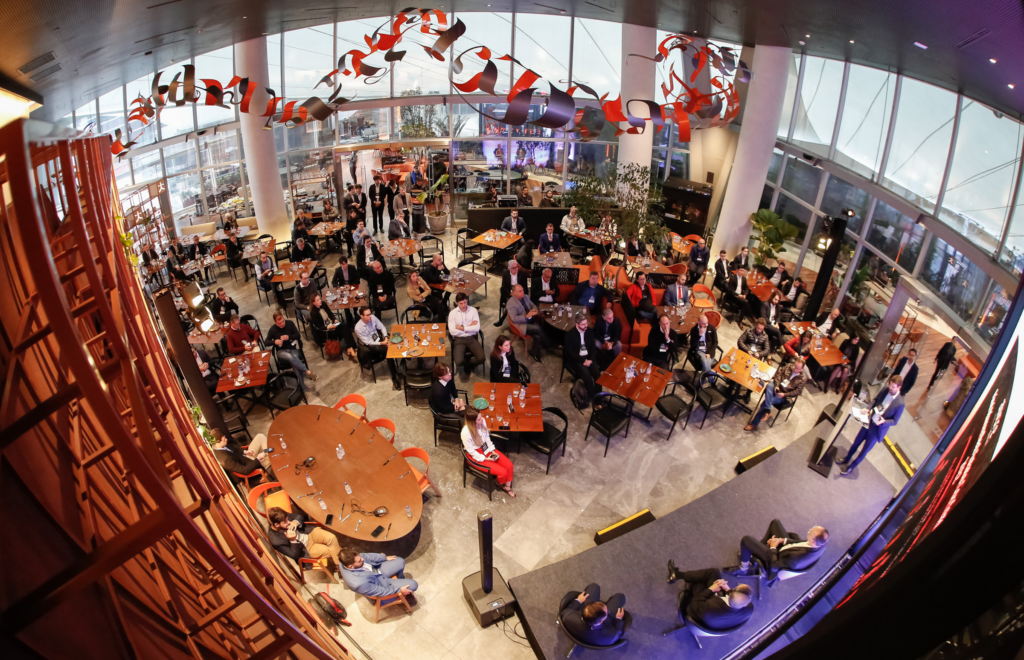
Two years after Ativore's last Real Estate event, we relaunched our series of annual conferences on the U.S. real estate market with the presence of the founding partners of Ativore Global – Pedro Barreto, Roberto Nishikawa and Renan Barros – and the CEO of JSB Capital Group, Jay Lobell, specialists and investors with decades of experience in this market.
The event consisted of three rounds of presentations and a panel with audience participation in which questions were posed to the speakers about the current macroeconomic environment and the build-to-rent opportunity in the U.S. residential market.
In this article, I share the 5 lessons I learned at this event. Enjoy the read!

1. In the U.S. real estate market, the play of the moment is the construction of residential properties for rent (residential Build-to-Rent).
If in 2020 and 2021 Ativore captured the post-COVID market distortions, which resulted in wide spreads between U.S. interest rates and property capitalization rates (cap rates) to assemble a diversified value-add portfolio¹, in 2022 the reversal of the market fundamentals observed over the previous two years opened the door to a new strategy: the construction of residential properties for rent. Based on the current housing deficit of 6.8 million units in the United States and the estimated demand for 16 million new homes over the next decade (Read more here), we believe that, by operating conservatively in the Build-to-Rent market, combining (1) entering projects at construction cost, (2) a lower level of leverage compared to operating projects, and (3) guarantees on maximum construction costs and timelines, we are investing in what may be the winning strategy in the real estate sector during this economic cycle.
2. The residential rental market in the United States (Real Estate) should remain strong in certain regions
The unprecedented imbalance between housing supply and demand, brought on by the 2008 crisis with the abrupt halt in the pace of construction and the slow recovery in subsequent years, caused the delivery of new residential units to fall far below what was needed for more than a decade, reducing vacancy in the United States to all-time lows and putting strong upward pressure on rental prices in certain regions. Recently, the residential market, which was already strong, gained even more momentum with the rise in interest rates, which (1) is a factor that slows new construction, reducing the supply of new housing, and (2) increases the cost of mortgages (mortgage rates), pushing the American middle class even further toward renting.
3. Residential properties, in regions with limited supply and aimed at Class A and B tenants, act as a hedge against inflation.
In the United States, over the last 50 years, rental prices and residential property values have always adjusted above U.S. inflation (the CPI), making investments in this asset class a powerful tool for protection against inflation. However, sustained increases in rental values are only justified if (1) there is more demand than supply in the area and (2) tenants have the ability to pay for those increases. That is why knowing how to identify the regions with the largest housing deficits, as in the case of Florida and other SunBelt states, and focusing on properties for Class A and B residents, whose salaries have historically been adjusted above inflation, with less impact on this group's ability to pay, is a more defensive and resilient strategy during inflationary periods.
4. You must buy the land well, finance the project well, and lock in construction costs! Getting the underwriting right is what will determine the success of the transaction.
Put simply, underwriting consists of estimating the potential return of a project while weighing its risks, a complex process and, in the case of real estate transactions, one with several variable factors. When underwriting, a fundamental part of the strategy of Ativore and JSB Capital Group involves mitigating two major risks: interest rates and inflation. Thus, from the financing standpoint (interest rate risk), opting for fixed rates, or variable rates with a limit (cap), allows for more precise financial modeling. On the construction side (inflation risk), it is possible to lock in the costs of raw materials and labor, as well as timelines, through a Guaranteed Maximum Price contract (GMP Contract). Therefore, in uncertain times, being able to accurately project stress scenarios, knowing the range within which a project's return may fluctuate, is essential for a safer decision-making process.
5. Finally, what can we expect from this ongoing environment of rising interest rates in the United States, especially with respect to the real estate market (Real Estate)?
After consecutive interest rate hikes by the Federal Reserve in an attempt to contain inflation, which is expected to continue at least until the end of 2022, it is difficult to have a clear view of the markets over the coming years. However, if there is one thing we have learned in decades of working in this sector, it is that different economic cycles require different real estate strategies. If in 2020 the spread between interest rates and property capitalization rates created great opportunities to purchase operating properties at prices discounted relative to replacement cost, in 2022 the historic gap between housing supply and demand formed over the last decade opens the door to implementing the Build-to-Rent strategy. By operating diligently, the coming years may bring rare investment opportunities in the U.S. real estate market.
Already counting down the days and excited for the next one. See you at the Ativore Real Estate Conference 2023!
Disclaimer: ¹ Value-Add consists of a strategy through which aesthetic and operational improvements are made to operating properties with the aim of increasing operating income and, consequently, the value of the property.